Campaigns move faster, but content teams can't. Is AI the lifeline?
Content is no longer just a campaign asset. It is the campaign. Marketing leaders deliver personalized, localized, and channel-optimized content at a velocity that few teams can sustain. Campaign timelines are shrinking, product lines are expanding, and audience expectations are higher than ever.
Yet, content teams remain bound by the same constraints: limited bandwidth, siloed tools, and manual processes. The pressure is mounting, and the traditional playbook is no longer enough.
Artificial intelligence (AI) is becoming the catalyst for change. According to IDC, 79% of marketers are already using AI to support content-related tasks. From drafting initial copy to generating multilingual variants and personalizing assets at scale, AI is quickly becoming embedded in the modern content workflow.
But this shift raises critical questions: Where does AI provide the most value across the content lifecycle? How are CMS, DXP, and CMP vendors enabling these capabilities? And what should organizations consider to ensure AI enhances, rather than disrupts, their content operations?
In this article, we dive into:
- Where AI drives efficiency and value across content stages
- How leading digital experience platforms are integrating AI
- Strategic considerations for implementing AI responsibly
For CMOs and digital leaders, now is the time to reimagine content operations before demand outpaces delivery.
Mapping the content lifecycle: Where AI comes into play
AI is not a monolithic solution but a set of capabilities that can be thoughtfully embedded across the content lifecycle. From ideation to optimization, AI helps marketing teams do more with less, reduce production cycles, and scale personalization efforts.
Here's how AI maps to each content stage:
| Stage | AI use case | Tools or capabilities |
|---|---|---|
| Ideation and planning | Topic suggestions, keyword clustering, and brief generation | Generative AI for content planning (e.g., MarketMuse, Writer, ClearScope) |
| Creation (copy and design) | AI copywriting, image generation, tone-of-voice consistency | Large language models and creative AI (e.g., Jasper, Adobe Firefly, Canva Magic Write) |
| Editing and QA | Grammar, style, tone checks, accessibility validation | Proofing and compliance engines (e.g., Grammarly Business, Writer Style Guide, axe Accessibility) |
| Localization | AI translation, cultural adaptation, glossary alignment | Neural machine translation and adaptive language models (e.g., DeepL Pro, Smartling AI, Phrase) |
| Segmentation and personalization | Variant creation for personas, A/B content versions | Predictive modeling and content AI (e.g., Optimizely, Sitecore Personalize, Adobe Target, Mutiny) |
| Publishing and orchestration | Auto-tagging, metadata enrichment, content scheduling | Content automation platforms (e.g., Contentful, Sitecore Content Hub, Kentico Xperience) |
| Analytics and optimization | Performance insights, predictive testing, feedback loops | Analytics and optimization engines (e.g., Optimizely FullStack, Adobe CJA, Sitecore Analytics) |
For example, ideation tools like Writer and Jasper generate outlines and creative briefs in minutes. During content creation, GPT-based assistants draft compliant, on-brand copy that reduces time to first draft by up to 80%. In localization, DeepL enables faster translation with glossary alignment, reducing reliance on external agencies.
AI enables a new model of content operations that are modular, scalable, and insight-driven.
Comparing AI capabilities in leading DXPs
Leading CMS and DXP vendors are embedding AI deeper into authoring environments, asset workflows, and testing tools, but the maturity of these features varies.
Here's a comparative snapshot:
Adobe
Asset processing, content generation, and workflow accelerationAdobe Sensei GenAI powers auto‑tagging, smart cropping, and content generation inside Experience Manager. Users report ~20‑30% faster production cycles and up to ~45% quicker iteration. Built‑in AI copilots support content reuse, approvals, and personalization.
Optimizely
Experimentation, predictive optimization, and automated decisioningOffers predictive content performance scoring, automated content tagging, and AI-powered personalization through Optimizely Data Platform. Features like "shop similar" modules and AI search recommendations have driven measurable impact, including a 200% increase in CTR. Organizations also report a 25–35% increase in content velocity as AI assists with page assembly, testing, and optimization.
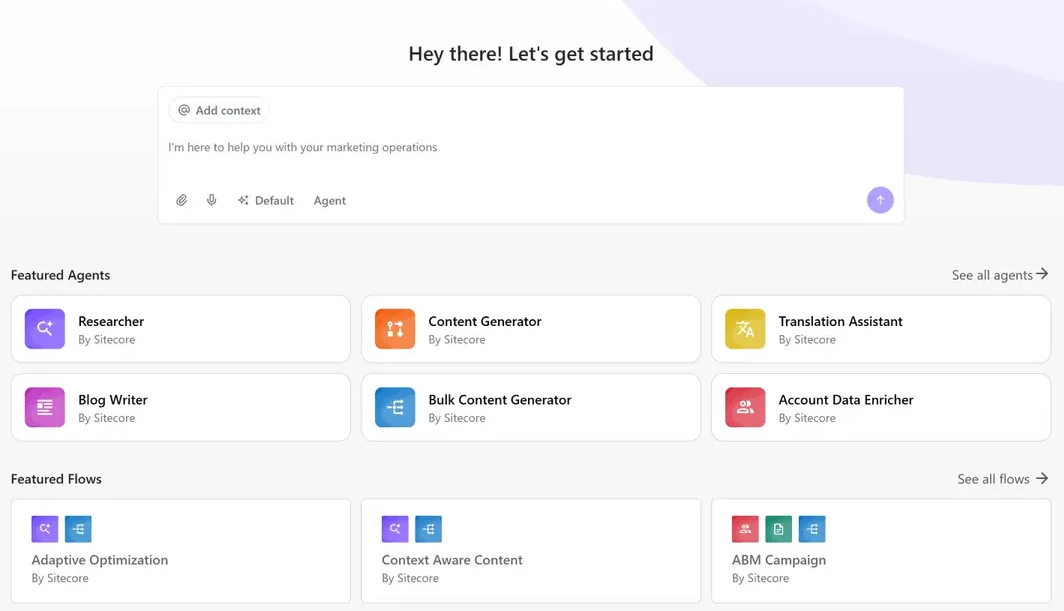
SitecoreAI
Agentic experience platform with content generation, reuse, and autonomous experience orchestrationCore features include AI copilots for content and design, structured content built for reuse by teams and AI agents, and a "fully agentic" content engine. Embedded A/B/n testing, real-time analytics, and guided content creation are built into the authoring experience. While specific productivity metrics vary, enterprise case studies report major improvements, such as a 3x lift in visitor-to-lead conversion.
Contentful
Composable content operations via APIs and external model integrationProvides flexible, composable architecture with open integrations (GPT, workflow APIs). Ideal for teams wanting to embed best‑in‑class AI via API rather than rely on deep native AI automation.
Kentico / Storyblok
Assisted content creation and basic personalizationOffers entry‑level AI capabilities (GPT‑based content assistants for ideation/drafting). Suitable for smaller teams or early‑stage adoption, but lacks full enterprise automation and built‑in AI workflows.
What this means for CMOs
AI capabilities across DXPs vary widely in how deeply they are integrated into the content workflow, and whether they align with your organization's maturity and scale requirements.
When evaluating platforms, focus on:
- How well AI supports personalization, testing, and real-time decisioning
- Whether capabilities are production-ready or still evolving on the roadmap
- How easily AI integrates into your existing workflows and operating model
To make your DXP implementation case even stronger, let's look upstream at how to create and scale content in Content Marketing Platforms.
Comparing AI capabilities in leading Content Marketing Platforms
While DXPs orchestrate and deliver experiences, much of the content lifecycle happens inside Content Marketing Platforms (CMPs) and content operations systems.
These platforms enable teams to plan, create, govern, and optimize content before it reaches the DXP layer.
AI adoption in CMPs is thriving in areas like:
- campaign planning and brief generation
- content production and reuse
- compliance and brand governance
- workflow automation and orchestration
Here's how these leading platforms compare:
Adobe AEM and GenStudio
Content generation, asset optimization, and performance analysisContent and image generation, auto-tagging, Brand Score, and Sites Optimizer enabling autonomous UX/SEO testing, driving +15% SEO visibility, +24% conversion uplift, and 3× faster issue resolution. (Source: Adobe Newsroom)
Optimizely CMP (Opal)
Workflow automation, campaign orchestration, and experimentationAI agents for drafting, experimentation, and campaign automation, as well as reducing campaign time by 53.7% while increasing campaign volume by 17.1%. (Source: The 2025 Optimizely Opal AI Benchmark Report)
Sitecore (Content Hub; Stream)
Brand-governed content generation and lifecycle orchestrationAI copilots, Translation Assistant, Brand Assistant, and agentic workflows across the lifecycle, contributing to up to 80% faster time-to-market and ~25% higher conversion rates. (Source: Sitecore Newsroom)
Contentful
Structured content automation and API-driven operationsAI Actions for bulk content generation, translation, and SEO optimization, along with AI Suggestions and embedded analytics for continuous optimization.
Kentico (Xperience; AIRA)
Guided content creation and journey optimizationAIRA Agentic Marketing Suite representing tools for content strategy, journey optimization, and governed AI workflows supporting structured campaign execution; AIRA Companion App is a mobile client enabling marketers to monitor KPIs, receive alerts, and capture or upload content directly from the field.
Storyblok
Assisted content creation and localizationAI translation, alt-text generation, and ideation tools, with most users reporting improved ROI and productivity after adopting headless CMS approaches. (Source: Storyblok CMS Report 2025)
HubSpot Content Hub (Breeze AI)
Multi-channel content generation and repurposingBreeze Copilot and Content Agent for content creation and remixing into multi-channel formats, cutting production time by more than half in real use cases.
Salesforce Marketing Cloud
Personalization, segmentation, and real-time decisioningEinstein Copilot for real-time personalization and send-time optimization, delivering up to 40% engagement increase and conversion improvements by up to 15%. (Source: verified case studies)
Aprimo
Content governance, compliance, and metadata automationAI agents for compliance validation, metadata automation, and intelligent content brief generation, reducing campaign planning from weeks to days. (Source: Aprimo)
Sprinklr
Content performance optimization and social channel executionContent scoring, budget optimization, sentiment analysis, and predictive analytics, improving campaign performance by up to 35%. (Source: Sprinklr)
What this means for CMOs
The choice of where to apply AI should be guided by platform function, not just feature sets.
- CMPs power content creation, governance, and scalability
- DXPs focus on content delivery, personalization, and experience optimization
AI maturity at the CMP layer often determines whether a DXP can deliver on its personalization promises. Without a scalable, AI-enabled content supply chain, even the most advanced DXP will struggle to perform.
What to consider before adopting AI in your content stack
Adopting AI in an enterprise content environment requires strategic foresight. It's not just about selecting tools; it's also about making smart decisions that balance automation with brand integrity, operational efficiency, and cross-functional adoption. Recent research and practitioner insights provide a clear framework for evaluating AI readiness and implementation success.
Thoughtful integration over blanket automation
A recurring warning from AI technologists and marketers alike is to avoid over-integration. Over-automating every part of content operations can lead to generic outputs and diminished brand authenticity. Organizations should first identify low-risk, high-impact use cases, like metadata tagging, content repurposing, and language adaptation, that deliver measurable value while preserving editorial quality.
Preserving human creativity
AI is proving most valuable not in replacing human creativity but in amplifying it — by surfacing insights, accelerating feedback, and revealing patterns that unlock new strategic possibilities. Leading CMOs are resisting the temptation to over-automate; instead, they use AI to elevate creative direction without surrendering it, with brand tone, emotional resonance, and storytelling remaining human domains. Marketers are learning that sustainable growth isn't driven by volume alone but by relevance and long-term value. In this shift toward more humanized growth, AI becomes the enabler, while people remain the voice, the vision, and the differentiator.
AI literacy and organizational change
Even the best AI tools underperform without informed users. Transparent processes, upskilling programs, and cross-functional ownership (e.g., involving marketing ops, data teams, and legal) are essential. CMOs must lead with a change-management mindset — adopting AI is as much about culture as it is about code.
Evaluation checklist
- Prioritize practical use cases before scaling across the stack.
- Implement human-in-the-loop review processes for all public-facing content.
- Look for AI tools that offer explainability, brand alignment, and ongoing support.
- Educate your teams and set realistic expectations around AI output quality.