The customer
Arabian Oud opened its first store in 1982 in Souk al-Azal, the old marketplace of Riyadh, with a single purpose: to source oud, one of the rarest raw materials in perfumery and the foundation of Middle Eastern fragrance for centuries.
Four decades later it is the largest Middle Eastern fragrance house in the world and a Guinness World Record holder as the largest premium unisex fragrance brand. The retail arm of Al Jasser Holding, it carries 400 distinct products across three brands—Arabian Oud, Oud Elite, and Arabian Blend—through 1,000 stores in 25 countries.
Fragrance is an unusually difficult category to sell online. Choosing a scent is personal and sensory, and the store does most of the persuading. Closing that gap was the real brief.
Guinness World Records: the largest premium unisex fragrance brand is Arabian Oud

A digital estate that did not behave like one
Each brand and each market had arrived at its own platform. Magento ran alongside Magento SaaS, WooCommerce, and OpenCart, and none of them spoke to the others. The approach was commerce-led rather than experience-led—built around the cart, with no central content management and little beyond what Magento offered out of the box.
The consequences compounded. Storefronts looked and behaved differently from one market to the next. Tools, teams, and data sat in separate silos. Pages loaded slowly, and publishing new content took long enough to matter in a business where retail moments are time-sensitive. The estate supported B2C only, with no B2B capability at all.
Then COVID-19 removed the fallback. More than 1,000 stores faced closures and restrictions, luxury fragrance was classed as nonessential in most markets, and a business built on in-person experience had to move online at speed.
Arabian Oud set three objectives:
- Deliver online experiences that matched the standard of the stores
- Grow revenue through omnichannel personalization across B2C and B2B
- Build a platform that would support expansion rather than constrain it
One of the largest Sitecore implementations in the world
Arabian Oud selected Sitecore. Brimit implemented, integrated, and configured eight SaaS products from Sitecore's composable platform, using Sitecore360 to accelerate deployment. What emerged was one of the largest Sitecore implementations in the world at the time, and a fully composable, cloud-based, headless architecture.
Engagement Cloud
- Sitecore Send—email campaigns and transactional email delivery
- Sitecore CDP—visitor behavior tracking, segmentation, and RFM analysis
- Sitecore Personalize—customer data driving personalized messaging and offers
Commerce Cloud
- Sitecore OrderCloud—customized B2C and B2B commerce and order management
- Sitecore Search (formerly Sitecore Discover)—AI-driven search, recommendations, and merchandising
Content Cloud
- Sitecore XM Cloud—digital experience and content management across brands and regions
- Sitecore Content Hub Operations—content workflow management
- Sitecore Content Hub DAM—digital asset management, including product information management
The platform was never Sitecore alone. Vercel hosted the web front end on serverless infrastructure. Oracle Integration Cloud synchronized ERP data in real time. Microsoft Azure Synapse carried analytics. Salesforce connected the back office. Native apps shipped through the Android and iOS stores. Composability was the point: each capability chosen on merit, connected through APIs, replaceable without rebuilding the rest.
Results
Traffic and engagement figures are from Google Analytics. Performance figures are Lighthouse scores, measured with all trackers and pixels enabled: the homepage moved from 13 on Magento to 60 on Sitecore, and product detail pages from 22 to 60. Personalization revenue attribution is from Sitecore Search analytics.
Increasing conversions and sales
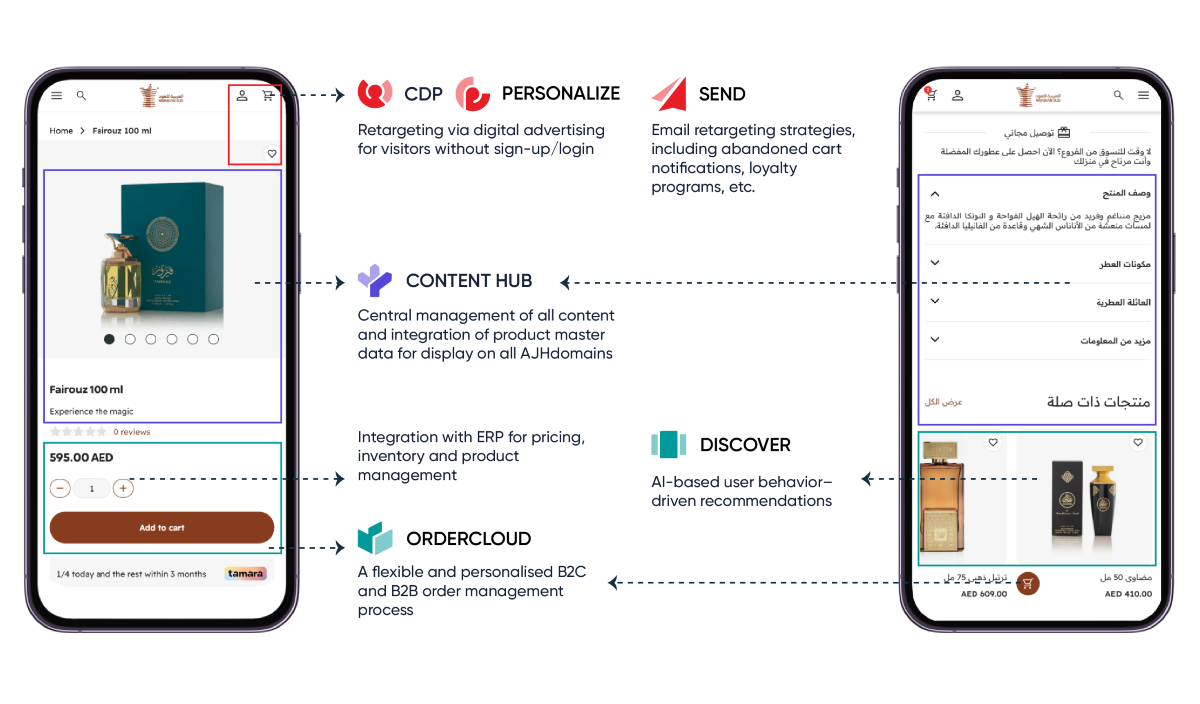
Growing digital revenue came down to making each journey feel considered rather than generic. That meant individualizing the journey across site, app, and email, taking full control of experience orchestration, and putting AI-driven recommendations in front of customers at the moments they were deciding.
AI-driven search and recommendations
Sitecore Search reads structured product data alongside real-time customer behavior to surface relevant results and recommendations, rather than following static merchandising rules. It handles product availability across markets, accounts for inventory, and supports multilingual discovery.
How well it performs depends almost entirely on the data feeding it. Brimit's Experience-Led Commerce Accelerator collects item data from across every Sitecore product on the platform, transforms it into a compatible feed, and loads it into Sitecore Search. That plumbing is unglamorous and decisive: without complete, structured product data, no recommendation engine performs, whatever the algorithm.
The measurable effect was significant. In March, roughly 20% of revenue came from purchases influenced by personalized interactions. By the first week of April, that figure had reached 46.6%.
Experience-Led Commerce Accelerator
Loyalty that works the same way everywhere
Arabian Oud runs its loyalty program on Tawasul. Before the platform work, online and offline loyalty operated as effectively separate schemes sharing a brand name.
The integration closed that gap. A customer logs in and the loyalty discount applies automatically in the cart. Once an order is placed, its details flow back into Tawasul. Online and offline orders count equally toward status, and tier-based promotions became straightforward to run across channels. For a retailer with 1,000 stores, that parity is the whole proposition.
Order management built on OrderCloud
Orchestrating orders cleanly is critical in a solution this size. Brimit's Order Management Pack for OrderCloud handles order processing, shipping, and returns, integrating directly with carriers rather than passing work between disconnected systems. It connects 16 delivery services, including FedEx, DPD, DHL, Aramex, Channels by STC, and ICP, alongside 8 payment gateways and 2 SMS gateways.
Applied across 1,000 stores in 25 countries, it saved Arabian Oud 200,000 USD a year.
Order Management Pack for OrderCloud
Maximizing digital channels and touchpoints
Matching the stores meant being present wherever a customer might encounter the brand, without rebuilding the commerce logic each time. Brimit delivered B2C, B2B, and franchise experiences from a single solution, adapted storefronts to their regions, and extended reach into marketplaces, vending machines, social networks, smartwatches, native apps on Android, iOS, and Huawei, and email.
Retargeting ran through Facebook, Instagram, TikTok, Snapchat, and Twitter, reaching visitors who had browsed without ever signing in.
A headless unified commerce platform
Decoupling the front end from the systems managing catalog, pricing, inventory, and orders meant the same product data could power any channel without duplicating business rules.
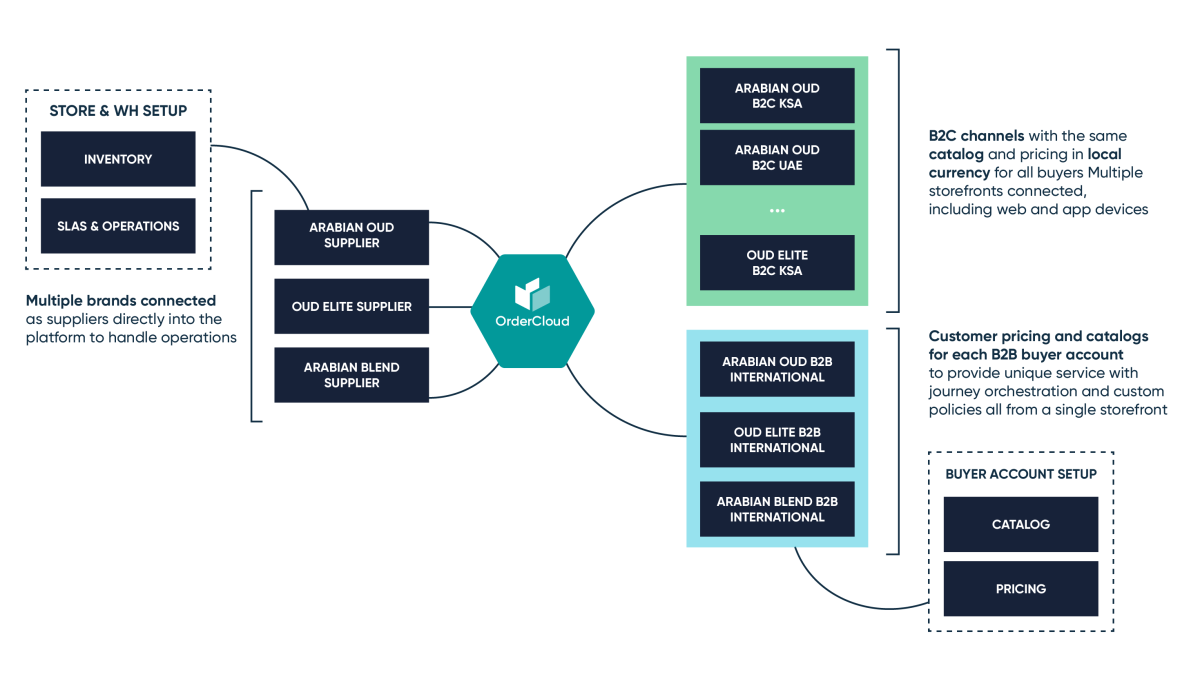
On OrderCloud, each brand's suppliers connected directly into shared inventory and operations. Every B2C storefront carried the same catalog priced in local currency. Every B2B buyer account carried its own catalog and pricing, with journey orchestration and custom policies, all served from one storefront. Shared platform, shared operations, independent commercial control per brand and per market.
More efficiency with the same resources
Consolidating content management across every brand and country onto Content Hub and XM Cloud cut duplicated effort and shortened time to market. Automated back-office workflows reduced manual handling and error rates in order processing and inventory. Connecting tools, teams, and data dismantled the silos between e-commerce and digital marketing, and teams could finally locate content for any product, channel, or region through varied search and filter criteria.
Launch times reflect the change. With payment and delivery services already integrated, a new storefront could go live in days rather than weeks. Extending into a new market, with language support and new payment and delivery integrations, took up to a month.
Data-driven commerce
Streamlining operations required complete, organized, analysis-ready data. The platform pulled together sources that had never been connected.
Online sales contributed e-commerce data from OrderCloud—prices, promotions, taxes, categories, taxonomies, catalogs, orders, items, statuses—alongside payment systems, shipping services, and tax data. Offline sales brought in vending machines. Oracle Integration Cloud synchronized ERP data in real time: cost of production, company finances, manufacturing and raw material purchasing, inventory levels, and real estate across owned, rented, and leased sites.
Analytics ran on Microsoft Azure Synapse, producing reporting on shipping and payment system performance, best-selling and most profitable items by region, order data, and daily snapshots.
Two systems became definitive. Content Hub held product information, translations, and digital assets for every brand and territory. OrderCloud held e-commerce data covering inventory, pricing, and promotions. Consistency and accuracy stopped being a reconciliation exercise.
People buy experiences, not products
Connecting best-of-breed technologies through cloud APIs on a modular platform gave Arabian Oud something its previous estate could not: the freedom to adopt what works next without dismantling what already does.
For a brand that spent four decades building its reputation on how a fragrance is chosen rather than simply sold, that flexibility was the point.
Technology Highlights
Project Highlights