Brimit analyzed 300 Dutch companies to understand what composable adoption really looks like in one of Europe's most digitally advanced markets.
For years, businesses have delivered digital experiences through monolithic platforms—all-in-one suites that combine content management, commerce, personalization, and analytics under one roof. These systems offered structure and simplicity, but today's market moves in weeks, not months. Success depends on launching fast, personalizing at scale, and connecting tools that work best for your business today.
A composable DXP takes a different route. Instead of a tightly coupled system, you assemble best-fit tools and connect them via APIs. Your CMS, commerce engine, CDP, search, and analytics all work together—each replaceable or scalable on its own terms.
But who's actually making this shift? And what do these companies have in common?
Since the Netherlands is one of our key markets, we sought to move beyond vendor claims and conference presentations to gain a deeper understanding of the actual adoption picture. We profiled 300 Dutch companies actively using composable technologies, combining technology stack data from BuiltWith with our own research into company characteristics, growth patterns, and market dynamics.
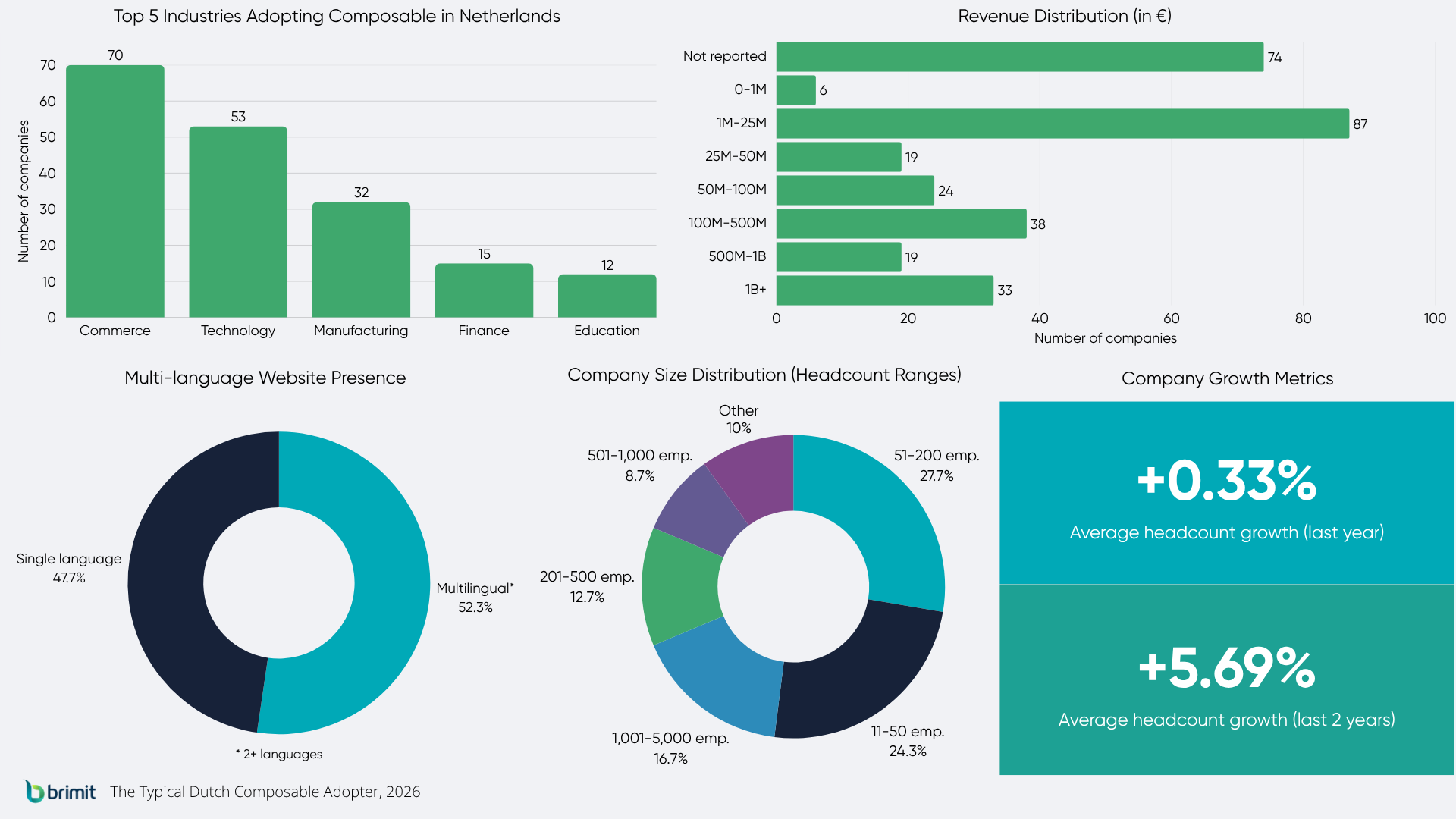
What we found: the typical Dutch composable adopter
Company profile:
Leading industries:
What surprised us: these aren't the enterprise giants typically featured in MACH Alliance case studies. They're growing mid-market companies that have chosen composable as their path to scale—not as a replacement for decades-old legacy systems, but as a way to build agile, future-ready architecture from the start.
Netherlands in global context
Our data shows the Netherlands ranks in the top 10 globally for composable tool adoption across three of four major categories we tracked: headless CMS, API-first commerce, cloud hosting, and modern front-end frameworks.
To understand where the Dutch market sits in the broader adoption curve, we compared our findings with the MACH Alliance's 2025 Global Research Report, which surveyed larger enterprises (€500M+ revenue, 5,000+ employees) across the UK, US, France, Germany, Canada, and Australia.
What the enterprise data reveals:
Nearly 70% of surveyed enterprises report high MACH maturity—either in widespread implementation or fully deployed across their organizations. Notably, companies aged 10–50 years show the strongest adoption, with organizations in the 25–49 year range leading in widespread MACH implementation. This suggests mid-lifecycle companies—not digital-native startups or legacy enterprises—are driving composable adoption at scale.
Industry alignment is striking: Retail, Manufacturing, Finance, and Technology lead in both our Netherlands SMB data and the global enterprise survey, confirming these sectors face universal pressure for speed, personalization, and multi-channel delivery.
The two-tier adoption pattern:
Companies with 11–200 employees and €1M–€25M revenue are in the experimentation phase. They're testing composable components, building internal expertise, and proving business value before committing to full-stack transformation.
Mature companies with 10–50 years of operation are in widespread or full implementation. They've moved past pilots and are scaling composable across their organizations.
The Netherlands' strong SMB adoption in our data, combined with global enterprise momentum, suggests the market is building from both ends. Smaller Dutch companies are establishing composable as their foundational architecture, while global enterprises are validating it at scale. The gap—mid-market companies with €25M–€500M revenue—represents the next wave of adoption, likely accelerating over the next 2–3 years as both reference cases and vendor ecosystems mature.
The technology stack: what Dutch companies are actually using
Our research revealed clear preferences in how Dutch companies assemble their composable stacks. Here's what we found across four critical layers.
Top vendors/products by category
Front-end hosting: global infrastructure, local performance
| Product | NL websites | Global rank |
|---|---|---|
| Cloudflare | 369,576 | 11 |
| Leaseweb | 57,861 | 2 |
| DigitalOcean | 43,380 | 5 |
| Microsoft Azure | 18,750 | 5 |
| Fastly | 12,830 | 14 |
| Vercel | 17,155 | 13 |
| Netlify | 10,385 | 11 |
| Firebase | 2,708 | 17 |
| Render | 213 | 19 |
| Railway | 391 | 13 |
Source: www.builtwith.com
Dutch companies overwhelmingly favor global cloud infrastructure that can scale elastically and deliver content at the edge. Cloudflare leads with 369,576 websites, followed by Leaseweb (57,861), DigitalOcean (43,380), and Microsoft Azure (18,750). Modern composable-native platforms like Vercel (17,155) and Netlify (10,385) are also gaining significant traction.
Netherlands' global position: median rank of 12th globally for front-end hosting platforms.
Headless CMS: high experimentation, no clear winner
| Product | NL websites | Global rank |
|---|---|---|
| Sanity | 1,100 | 8 |
| Contentful | 799 | 6 |
| Prismic | 490 | 5 |
| Strapi | 114 | 9 |
| Storyblok | 136 | 3 |
| Hygraph | 118 | 6 |
| Directus | 53 | 5 |
| Sitecore AI | 88 | 5 |
| Builder.io | 72 | 10 |
| Contentstack | 107 | 7 |
| Kontent.ai | 72 | 4 |
| Magnolia | 60 | 9 |
Source: www.builtwith.com
The headless CMS landscape shows remarkable diversity. Sanity leads with 1,100 Dutch websites and is pulling ahead, followed by Contentful (799) and Prismic (490). But what's striking is the presence of 12+ platforms in active use—Storyblok, Strapi, Hygraph, Directus, Sitecore AI, Builder.io, Contentstack, Kontent.ai, and Magnolia—all with meaningful adoption.
Netherlands' global position: median rank of 7th globally across headless CMS platforms—among the highest adoption rates worldwide.
E-commerce engines: legacy platforms still strong, but composable gaining ground
| Product | NL websites | Global rank |
|---|---|---|
| Adobe Commerce (Magento) | 6,540 | 3 |
| Shopify Plus | 1,701 | 7 |
| Elastic Path | 173 | 1 |
| SF Commerce Cloud | 144 | 8 |
| BigCommerce | 108 | 31 |
| commercetools | 57 | 7 |
Source: www.builtwith.com
Adobe Commerce (Magento) dominates with 6,540 websites, reflecting the platform's long-established presence in the Dutch market. Shopify Plus follows with 1,701 sites. However, composable-native platforms are making notable inroads: Elastic Path (173 sites, #1 globally), SF Commerce Cloud (144 sites), BigCommerce (108 sites), and commercetools (57 sites, #7 globally).
Netherlands' global position: median rank of 7th globally for e-commerce platforms—strong mid-tier adoption.
Customer data platforms: strong local presence, growing international competition
| Product | NL websites | Global rank |
|---|---|---|
| Spotler Activate | 1,131 | 1 |
| BlueConic | 474 | 2 |
| Tealium | 359 | 27 |
| Commanders Act | 64 | 10 |
| Zeotap | 40 | 11 |
| Treasure Data | 6 | 23 |
Source: www.builtwith.com
While Dutch platforms Spotler Activate (1,131 websites, #1 globally) and BlueConic (474 sites, #2 globally) maintain leadership positions, international platforms like Tealium (359 sites) are gaining ground, reflecting the increasingly global nature of the composable ecosystem.
Netherlands' global position: a median rank of 10th globally, but #1 and #2 positions for Dutch-built platforms show category leadership.
Key observation: The Netherlands consistently ranks in the global top 10 for composable technology adoption across nearly every category. In several cases—particularly headless CMS and CDPs—Dutch companies are punching well above their weight relative to market size, indicating both early adoption and strong ecosystem support.
| Netherlands' global ranking across composable stack layers | |
|---|---|
| Category | Global ranking |
| Customer data platforms | 10 |
| E-commerce engines | 7 |
| Front-end hosting | 12 |
| Headless CMS | 7 |
Source: www.builtwith.com
Why this matters
For the market: The composable shift isn't just happening at the enterprise level. Growing businesses with €1M–€25M revenue are choosing modular architectures from the start, which suggests composable is becoming the default, not the exception.
For Dutch companies specifically: The companies we studied aren't waiting for perfect conditions or massive budgets. They're globally focused, growth-oriented businesses that need their technology to move as fast as their markets do. Composable gives them that flexibility.
What's driving adoption:
- Need for speed. Customers expect seamless, personalized journeys across every channel. Marketing teams need to launch campaigns quickly and adapt in real time. Today's market moves in weeks, and monolithic platforms can't keep pace.
- Global expansion. Companies already operating internationally need multi-market, multi-language capabilities without the constraints of rigid, all-in-one systems.
- Flexibility over vendor lock-in. Legacy monoliths lock teams into slow cycles, proprietary stacks, and features you pay for but don't use. Composable gives you the freedom to connect the tools that work best for your business.
- Access to talent. Finding developers with React/Next.js skills is significantly easier than securing specialists for legacy platforms.
Industry spotlight: why commerce leads
Commerce and retail companies are the clear frontrunners in composable adoption—both in our Netherlands data and in global enterprise surveys. This makes sense:
- Omnichannel complexity. Modern retail spans web, mobile, marketplaces, social commerce, and physical stores.
- Peak season pressure. Black Friday, holidays, and flash sales demand infrastructure that won't collapse under traffic spikes.
- Personalization at scale. AI-driven recommendations and dynamic pricing require real-time data flows.
- Time-to-market competition. The brand that launches fastest often wins the customer.
These aren't nice-to-haves—they're survival requirements. Monolithic platforms built for the 2010s e-commerce can't meet 2025's demands.
Methodology
We identified 300 Dutch companies using composable technologies by analyzing four key stack layers: headless CMS platforms, API-first commerce engines, cloud-native hosting, and modern front-end frameworks. Technology stack data came from BuiltWith, which we then enriched through our own research using LinkedIn, company reports, public financial data, and open sources. After removing duplicates and filtering for Netherlands headquarters, we analyzed company characteristics—including size, revenue, growth rates, industry, and international presence—to build a comprehensive profile of composable adoption in the Dutch market. Technology stack data was collected in Q1 2026, reflecting current market adoption.
Looking for commentary or insights? If you're a commerce or technology leader with experience in this space, we'd love to hear your perspective. Reach out to marketing@brimit.com.
Authors: Nikita Tristen, Alexander Vergeichik.
Brimit is a digital experience consultancy with over a decade of experience helping businesses across the USA, Europe, and MEA transform their digital experiences. We specialize in DXP and e-commerce implementations, with deep expertise in composable architectures, platform migrations, and scalable solutions for mid-market and enterprise companies.